
Pistol squat: how to learn the one leg squat
A pistol squat is a squat on one leg. You sink all the way down on your standing leg, your other leg floats straight out in front of you, and you stand back up on that same leg. Single leg squat and one leg squat are other names for the same exercise. You learn it step by step: first a deep squat with your feet together, then lowering to a box, then with support, then slow lowering, and only after that fully free.
Can't do one yet? Completely normal. A pistol asks for strength, mobility, balance and coordination all at once. Miss one of those and you'll tip over or get stuck at the bottom. Below you'll find what you need, how to build up to it and which mistakes are worth avoiding from day one.
Free Fit Test · 1 minute
Now you know how the exercise works. Do you know where you stand? Take the free Fit Test: 7 questions, 1 minute.
7 questions. Your score on rhythm, strength and conditioning appears right away, no email needed.
Updated: 2026-11-27
What is the pistol squat?
The pistol squat is the hardest version of the squat without weights. You stand on one foot, reach the other leg forward and go as deep as you can. Your whole bodyweight sits on one leg. That takes a fair bit of strength compared to what you weigh.
It's also a proper CrossFit movement. It shows up in workouts as a way to train one leg at a time, and you can scale it so everyone can do a version of it. If you want the basics first, read our guide to the squat. That's the move the pistol is built on.
What you need: strength, mobility and balance
Most people think the pistol is only about leg strength. It isn't. You need three things, and the weakest one decides how far you get.
- Strength. Your thigh and bum muscles lift your whole bodyweight from the bottom on one leg. Squats, lunges and split squats build that.
- Mobility. Your ankle needs to bend, your hip needs to fold and the back of your standing leg needs some stretch, because the other leg is reaching straight out in front.
- Balance and control. One foot, one point of support. Your knee, hip and foot need to work together so you don't wobble sideways.
A quick test: can you sit in a deep squat with both feet flat and your heels on the floor? If yes, you have most of the mobility you need to start. If your heels lift, start with the mobility work further down. That's a perfectly good starting point.
Progression in five steps
Don't jump to the one-legged version. Move on to the next step only when the current one feels solid and controlled. That might take weeks. It might take months. That's fine.
- Deep squat with your feet together. Sit all the way down with your heels on the floor and stand back up. This is your mobility check and your base. A goblet squat, holding a weight in front of your chest, helps you stay upright.
- Lower to a box. Stand on one leg in front of a box or bench. Sit back slowly onto it with the other leg out in front, then stand up on that same leg. Start with a high box. Lower it over time as you get stronger.
- With support. Hold a door frame, a rope or a rig post (the frame in the box) with both hands and do a full pistol while pulling lightly. Use as little help as you can. The support is there so you can learn the full depth without falling.
- Slow lowering. Stand on one leg with no help and lower yourself slowly all the way down, taking three to five seconds. Then use two legs to stand up. The slow lowering builds the strength you need for the way back up.
- The free pistol. Go down on one leg, hold your other leg out straight and stand up on that same leg. Keep your heel on the floor and your chest up. Do a few clean reps with good control before you add more.
Tip: do each step on both legs. Most people have a stronger side. Start with your weaker leg so you don't let the strong one do the work.
This is where a coach makes a real difference. Which step is right for you today? How high should your box be? Is your knee caving in? You don't have to guess. In our classes a coach watches you move and scales the exercise to your level, so you don't have to work out the plan yourself.
 7 questions
Free Fit Test · 7 questions · 1 minute
Now you know how the exercise works. Do you know where you stand? Take the free Fit Test: 7 questions, 1 minute.
Rate yourself too low and you never start. Too high and you start too hard.
Seven questions you answer from memory. Your score appears right away, no email needed. No judgement: you compare yourself with yourself.
- Your score on rhythm, strength and conditioning, and which of the three holds you back most
- The test every Strong Start with us begins with, in a version for home (no rower, no bar)
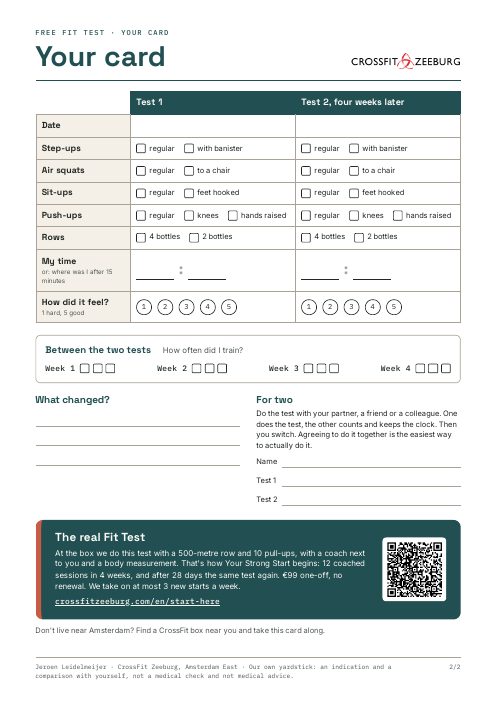
- The card that shows you in black and white, 4 weeks from now, whether you improved
By Jeroen Leidelmeijer, coach at CrossFit Zeeburg. Teaching since 2012.
What do you want most?
Pick what fits best. There's no wrong answer.
Free. You see your score right away. Our own yardstick, not a medical check.
Common mistakes
- Heel lifts off the floor. Usually it's an ankle mobility issue. Go back to the mobility work or put a small plate under your heel for now.
- Knee falls inwards. Push your knee out in line with your toes, all the way up and all the way down.
- Dropping instead of lowering. Falling down and bouncing out of the bottom is hard on your knee. Go down slowly and stay in control.
- Leaning too far forward. Your chest folds towards your leg and you tip over. Reach your arms forward as a counterweight and keep your chest up.
- Skipping steps. Going straight to the free pistol is how people get stuck or sore. Build it up, one step at a time.
- Only training your strong leg. Do both sides, and start with the weaker one.
Got knee, hip or back problems, or are you coming back from an injury? Check with your doctor or physio before you start. Your coach can then adjust the exercises. We don't take over the role of your doctor or physio.
Mobility for the pistol
If you get stuck at the bottom, mobility is often the reason. These drills help, and you can do them as part of a warm-up before you train.
- Ankle: kneel in a half-kneeling position and push your front knee forward over your toes, with your heel down. Do this slowly, for a few reps on each side.
- Deep squat hold: sit in the bottom of a squat, hold on to something in front of you and rock gently side to side.
- Hip: from the deep squat, push your knees out with your elbows and keep your chest up.
- Back of the leg: with your leg straight out in front on a low step, hinge forward from your hips with a flat back until you feel a stretch.
Do these a few times a week. Small amounts done regularly work better than one long session. For strength, Bulgarian split squats are a great next step, because they train one leg at a time with a bit of help from your back foot.
Learn it with a coach next to you
You can learn the pistol on your own. But it's easier with a coach who tells you which step to do, who looks at your knee and heel, and who gives you a lighter or harder version when you need it. And when you train in a group, you're less likely to skip the session. You get a spot in the class and people notice if you're not there.
Not sure yet? Try it first. You can do two weeks of unlimited training and see how it feels. Or look at the schedule to see when classes run at Cruquiusweg 96F in Amsterdam East.
Want your first pistol squat? Build the strength first.
Your Strong Start is a guided start at CrossFit Zeeburg. A coach looks at how you squat, scales every exercise to your level and builds you up step by step, so one leg gets strong in the right order. You don't have to make a plan or work out which weight to take. You just show up.
- 12 coached CrossFit sessions in 4 weeks, around 3 a week
- A personal starting assessment plus scalable Fit Test as your baseline
- A midway check, so one busy week doesn't break your rhythm
- Final assessment and repeat Fit Test: you see what changed
4.9 out of 5 on Google · 153 reviews
Short excerpts from public Google reviews.
€99 one-off
12 sessions · personal guidance · no membership
No experience needed. No programmes to figure out. No subscription quietly running on.
Frequently asked questions
Is a pistol squat the same as a single leg squat?
Yes. Pistol squat, single leg squat and one leg squat all describe the same thing: a full squat on one leg with the other leg held out in front.
How long does it take to learn a pistol squat?
It depends on your starting strength and mobility, so nobody can give you an honest fixed number. Some people need weeks, others months. Train it regularly, move up a step only when the current one feels solid, and it will come.
Why can't I get my heel to stay on the floor?
Most often your ankle doesn't bend far enough yet. Do the ankle and deep squat drills a few times a week, and put a small plate under your heel while you build mobility.
Can I learn the pistol squat if I'm a beginner?
Yes, but start with the first steps: the deep squat, then the box. A coach can scale it to your level so you start in the right place.
Is the pistol squat bad for your knees?
Done slowly and with control, it's a normal strength exercise. Dropping down fast or letting your knee fall inwards is what causes trouble. If you have knee pain or an injury, talk to your doctor or physio first.